The Story
Vegetarian curry wrapped in roti is one of the oldest expressions of Indo-Caribbean cooking — rooted in the Hindu dietary traditions that the 238,909 Indian indentured labourers brought to British Guiana between 1838 and 1917. The majority of these workers came from North India's Bhojpur and Awadh regions, and 85% were Hindu — a faith whose culinary traditions have, for millennia, built extraordinary flavour from vegetables, legumes, and spice alone. When they arrived in Guyana, they brought this vegetarian fluency with them, and it found new ingredients in the tropical landscape: christophene, pumpkin, bora beans, eddoe, and the channa (chickpeas) that became a staple of Indo-Guyanese cooking.
The most sacred expression of this tradition is the "Seven Curry" — served exclusively at Hindu weddings and religious functions in Guyana, consisting of seven distinct vegetarian curries (typically pumpkin, mango, bhajee, baigan, eddoe, catahar, and channa with potato) presented together on a water lily leaf and eaten by hand, without cutlery. Each curry carries its own symbolic meaning within the ceremony. The Seven Curry tradition is considered a uniquely Guyanese creation — born from the meeting of North Indian Hindu cooking and the tropical produce of the Demerara coast. It demonstrates that vegetable curry in the Caribbean is not a compromise or a substitute: it is the original, the sacred, the most deeply considered form of the cooking.
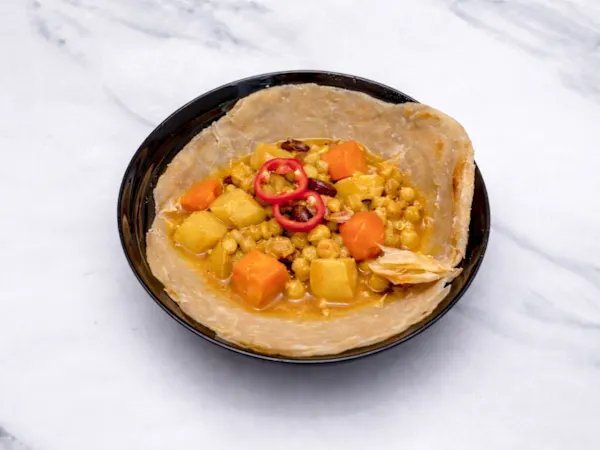
Our Roti & Veg Curry honours that lineage directly. The paratha roti is hand-rolled and clapped in the Guyanese style — soft, flaky, and laminated with oil so it tears into silky sheets that carry the curry beautifully. The chickpea, carrot and potato filling is spiced with our Guyanese masala blend: turmeric, cumin, shadow beni, and a touch of wiri wiri heat. It is a wholly satisfying meal that requires nothing else alongside it — and carries within it the ingenuity of a community that built an entire cuisine from the ground up, in a country not their own.